
Faced with rising energy costs and national targets for accelerating solar energy development, businesses have a real opportunity to reduce their electricity bills, lower their carbon footprint, and strengthen their energy resilience. This guide outlines the key steps in a professional photovoltaic project, the available support mechanisms, and the priority technical criteria to consider.
What are the advantages of solar panels for professionals?
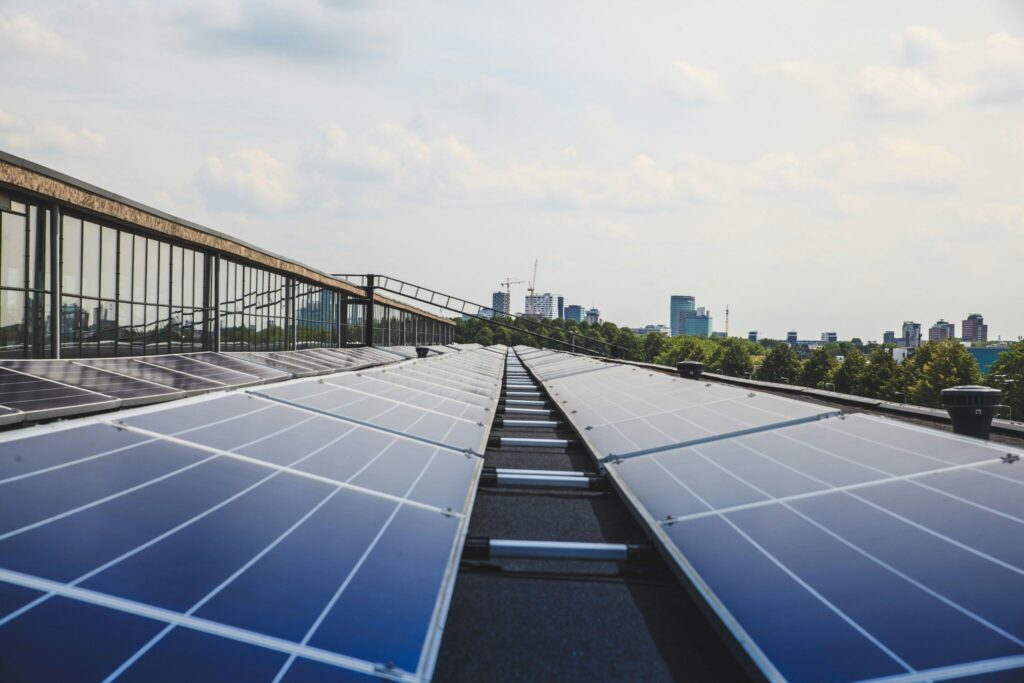
Installing solar panels in a business is a sustainable and efficient solution to reduce energy costs and produce your own solar electricity.
The benefits are numerous:
- Economic benefits : reduced energy costs and stabilization of the price of kWh in the long term.
- Environmental : direct contribution to reducing the carbon footprint and to an eco-responsible approach.
- Strategic : strengthening the CSR image and anticipating future environmental obligations.
Energy savings can reach up to 40% for high-energy-consuming commercial buildings, according to studies by ADEME. The profitability of an installation depends primarily on the self-consumption rate, the initial cost, and the level of sunshine.
What types of solar panels are available for professionals?
The professional market offers several photovoltaic panel technologies adapted to each context:
- High-performance monocrystalline panels : high yield for company roofs with limited surface area.
- Bifacial panels : capture light on both sides, ideal for parking lot shade structures.
Read also: Large company car parks regulated by the APER law
- Double-glazed panels : enhanced durability and better resistance to climatic conditions.
- Full black panels : homogeneous aesthetic for visible commercial buildings.
Ready-to-install self-consumption solar panel kits may be suitable for small structures, while custom installations are recommended for industrial sites with high photovoltaic energy demand .
How to install solar panels in a business?
Theinstallation of solar panels in a professional setting follows several steps governed by regulations:
- Feasibility study and energy audit.
- Administrative procedures : filing of a prior declaration or building permit depending on the size and location.
- Choosing the equipment and the photovoltaic installation partner.
- Installation and connection to the electrical network.
- Commissioning and signing of the purchase or self-consumption contract.
Small structures can use a self-consumption solar kit to simplify the procedure, but a professional installation requires the intervention of a expert to ensure technical compliance and safety.
What financial assistance is available for installing solar panels?
The State actively supports the development of solar energy in businesses through several programs:
- State aid for studies and investments (ADEME).
- Regional or European photovoltaic subsidies (ERDF)
- Self-consumption bonus for installations ≤ 500 kWp.
- Purchase obligation : EDF OA or other approved buyers purchase the electricity produced at a regulated tariff.
These public subsidies are governed by energy regulations , which are regularly updated through tariff decrees. Expert support helps optimize access to these programs and ensure the project's profitability.
What is the return on investment for solar panels?
The return on investment (ROI) depends on the installation cost , the self-consumption rate, and the annual solar production . On average, a properly sized installation reaches profitability in 7 to 10 years , with a module lifespan exceeding 25 years. Producing green, locally generated electricity helps offset market price increases and improves the company's environmental impact through the use of clean, renewable energy.
How to reduce your electricity bill with solar power?
Photovoltaics enables a reduction in fixed costs and a sustainable decrease in energy bills . By producing and consuming its own solar energy , the company reduces its dependence on the grid and the volatility of electricity prices. Total or partial self-consumption optimizes internal energy use , while selling surplus energy strengthens the project's financial performance. These levers support the transition to a more stable and competitive renewable energy source .
What are the risks associated with installing solar panels?
Like any technical project, solar installations present certain risks :
- non-compliance in the event of an administrative or technical error.
- Electrical or waterproofing risks if the installation is not carried out by a QualiPV qualified installer
- Insurance : the coverage must be adapted to a photovoltaic installation.
- Preventive maintenance is mandatory to avoid performance losses.
Powesco supports its clients to secure the process, guarantee the conformity of installations and ensure contractual and technical monitoring over time.
Banner: Discover our solar self-consumption offer for professionals


Preliminary checklist for a decision-maker
1. Define the project objective (self-consumption vs. resale)
The first decision concerns the economic model:self-consumption (consuming the production on-site, possibly selling any surplus) or selling all of the production to the grid. Support schemes and contractual terms differ depending on the option chosen; self-consumption is often recommended when consumption occurs primarily during the day.
2. Feasibility study and financial support
Companies can apply for feasibility study assistance and subsidies through programs run by ADEME and government ministries, particularly for preliminary studies (identifying roof constraints, energy calculations, financing plans). This assistance facilitates the financial structuring of the project and access to investment models (capital expenditure, third-party financing, energy leasing).
3. Sizing and essential technical criteria
For a professional project, the sizing is based on:
- analysis of profiles (peak hours day/night),
- the surface area and orientation of roofs or shade structures,
- The technological choice (monocrystalline, bifacial modules, bi-glass) depends on the site and sustainability objectives.
- taking into account constraints (building, safety standards, roof stability).
It is recommended to integrate maintenance and monitoring to guarantee long-term performance.
4. Regulations, connection and administrative procedures
Connecting to the public grid (Enedis or local operator) and signing a contract for self-consumption or resale are mandatory steps. Administrative procedures include submitting a connection application , potentially applying for planning permission, and complying with the tax regulations applicable to electricity production.
5. Aid, bonuses and pricing of the surplus
Support mechanisms have recently changed: the amount of investment grants and the feed-in tariff for surplus electricity have been revised, impacting the profitability of small and medium-sized projects. It is recommended to verify the applicable conditions based on the date the grid connection application was submitted and to rely on an up-to-date financial model before making a decision.
Reduction in the amount of the investment bonus
The amount of this subsidy is now €80 per kilowatt-peak (i.e., a subsidy of €240, for example, if you install photovoltaic panels with a combined power output of 3 kWp). Previously, the amount of this subsidy was €220/kWp for installations with a power output of 3 kWp or less, and €160/kWp for installations with a power output of 9 kWp or less.
Reduction in the purchase price of surplus electricity
The purchase price of your surplus electricity is now set at 4 euro cents per kilowatt-hour (kWh), compared to 12.69 euro cents per kilowatt-hour previously.
Reduction in VAT on the installation of photovoltaic panels
Since October 1, 2025, the VAT on the installation of photovoltaic panels of less than 9 kWp is 5.5% ; it was 10% for installations with a power of less than or equal to 3 kWp and 20% for those with a power greater than 3 kWp.
6. Economic impacts and national objectives
The Multiannual Energy Programme (PPE) sets ambitious targets for the development of photovoltaics by 2028 and 2050 ; these trajectories reflect a national framework favorable to solar investments , which can offer an attractive payback period depending on the financing chosen and the self-consumption/surplus sales ratio. Civil society actors and professional associations monitor and evaluate these policies to ensure balanced territorial deployment.
Why use Powesco
Powesco supports companies at every stage: initial energy audit, feasibility study, financial structuring (including third-party financing), assistance with administrative and contractual procedures, and performance management (monitoring and maintenance). Our approach integrates energy cost reduction,tax optimization , and operational site security—essential elements to guarantee the project's viability over 10–20 years.
Example of a Powesco offer :
- Diagnostic and preliminary study (consumption, roofs, constraints)
- Detailed study + feasibility (eligibility for ADEME funding)
- arrangement (third-party financing offer)
- Site management & connection
- Energy performance contract + monitoring ( energy management system type )
Conclusion
Photovoltaics is now a mature solution supported by a public regulatory and financial framework. For companies looking to reduce costs and advance their CSR objectives, the key to success lies in a rigorous feasibility study, a suitable financial plan, and professional operational support. Powesco offers comprehensive support to transform these opportunities into concrete results.
Request a preliminary feasibility study for your site and receive a cost estimate and an operational action plan.
FAQ
What is the cost of a solar installation for commercial premises?
The cost depends on several factors: available ground or roof space, installed power in kWp, panel type (glass-on-glass, full black, bifacial), and technical equipment such as the inverter and storage batteries. On average, the price of a professional photovoltaic system ranges from €900 to €1,500 per kWp installed, but this investment is quickly recouped thanks to reduced energy bills and available subsidies.
Is the installation of solar panels suitable for agricultural or industrial buildings?
Absolutely. Agricultural sheds, industrial roofs , and other large covered spaces are particularly well-suited to solar power plants. Their vast surface area offers high energy potential and allows for increased profitability. Powesco tailors each project to the specific challenges of the industry.
Sources:
https://www.service-public.gouv.fr/particuliers/actualites/A18205