

Measuring their carbon footprint has become a priority for companies that want to anticipate regulatory changes, reduce their energy costs, and commit to a serious climate transition. But with the various legal obligations and available methods, it's difficult to know where to start. Regulatory GHG assessment, the ADEME's Carbon Footprint® methodology, scope 1, scope 2, scope 3… Here is a comprehensive guide to understanding the issues, identifying your obligations, and above all, knowing how to move from measurement to action.
What is a carbon footprint?
A scope 1, 2, and 3 carbon footprint assessment is a carbon accounting tool used to evaluate the overall environmental impact of an organization. It measures greenhouse gas (GHG) emissions, such as carbon dioxide and nitrous oxide, across the entire value chain. Its objective, as defined by ADEME (the French Agency for Ecological Transition), is to identify and leverage opportunities for reducing emissions.
In practice, the exercise involves identifying all sources of emissions (from the company's boilers and vehicles to raw material purchases and electricity consumption) and then converting them into CO₂ equivalent (tCO₂e) using standardized emission factors. This assessment then serves as the starting point for defining a decarbonizationstrategy.
To organize this census, emissions are classified into three areas, called scopes, the definition of which comes from the international GHG Protocol standard:
- Scope 1 (Direct Emissions): This includes emissions from sources owned or controlled by the company. This includes the combustion of fuel (company vehicles) or natural gas in your facilities and offices.
- Scope 2 (Indirect energy-related emissions): This corresponds to the consumption of purchased electricity, heat, or steam. This is where the energy mix and the use of renewable energy play a key role in energy efficiency.
- Scope 3 (Other indirect emissions): This is often the largest category (sometimes representing 80% of the total). It includes emissions associated with the supply chain, the transport of goods, commuting, and the use of products sold.
In France, two main approaches coexist: the regulatory GHG emissions assessment, mandated by law for certain companies, and the ADEME's Carbon Footprint Assessment®, a more comprehensive method that covers all three scopes. These two frameworks address different needs, and their scope is not identical.
The regulatory carbon footprint (BEGES)
Who is affected?
Established by the Grenelle II law in 2010 and included in article L. 229-25 of the Environmental Code, the mandatory BEGES applies to the following organizations:
- Private companies with more than 500 employees in metropolitan France (250 in overseas territories);
- Local authorities with more than 50,000 inhabitants ;
- institutions with more than 250 employees ;
- State services (ministries, prefectures).
The reporting frequency is set at every four years for companies and private legal entities, and every three years for local authorities and public bodies. The report must be published on the dedicated national platform administered by ADEME (bilans-ges.ademe.fr). Since 2022, groups have also been able to publish a consolidated report for all their French subsidiaries, simplifying multi-entity processes.
Scopes 1 and 2: the basic perimeter
The regulatory framework for greenhouse gas emissions (GHG) mandates, at a minimum, the accounting of scopes 1 and 2. These two scopes constitute the legal minimum for the vast majority of organizations concerned. Since the decree of July 1, 2022, companies subject to the Non-Financial Performance Statement (DPEF) (i.e., the largest listed companies) have the additional obligation to include significant indirect emissions from scope 3. This obligation came into effect for these companies in 2023.
Furthermore, the BEGES must be accompanied by a transition plan outlining the objectives, resources and actions envisaged to reduce emissions.
Stricter sanctions
Failure to comply with BEGES obligations exposes organizations to significant financial penalties. Since the Green Industry Act came into force in October 2023, fines have increased fivefold:
- Up to €50,000 for failure to complete or submit the balance sheet;
- Up to €100,000 in case of repeat offence.
Furthermore, since June 2024, access to public funding for the ecological and energy transition has been conditional on compliance with BEGES (Greenhouse Gas Emissions) standards. Companies failing to meet these standards may also be excluded from public procurement and concession contracts. Despite these constraints, the compliance rate remains a concern: only 31% of the organizations concerned met their obligation in 2018.
The limitations of the regulatory BEGES
Limiting oneself to scopes 1 and 2 means observing only a small fraction of the company's true footprint. Direct and energy-related emissions generally represent only 10 to 30% of the total (the remaining 70 to 90% fall under scope 3, which is outside the mandatory scope for most organizations).
This gap is strategically problematic: without visibility across the value chain, it's impossible to effectively manage the most impactful reduction levers. The regulatory GHG emissions assessment is a compliance requirement, not a climate management tool in the true sense of the term. This is precisely where ADEME's Carbon Footprint® methodology comes in.
The ADEME Carbon Footprint®: the complete ABC method
Scopes 1, 2 and 3 are at the heart of the method
Developed from 2000 onwards by Jean-Marc Jancovici for ADEME and officially recognized in 2004, the Bilan Carbone® method was entrusted in 2011 to the Association for Low Carbon Transition (ABC). It is now the most widely used French reference for carrying out a complete carbon footprint assessment, covering all three emission scopes without exception.
Unlike the regulatory BEGES, the Carbon Footprint® method adopts a comprehensive and strategic approach:
- Scope 1 : direct emissions (vehicles, heating, processes).
- Scope 2 : emissions related to energy consumed (electricity, purchased heat).
- Scope 3 : all indirect emissions in the value chain: purchases of goods and services, upstream and downstream transport, employee travel, fixed assets, waste, use and end of life of products sold, investments.
The method is based on the ADEME's Footprint Database®, a regularly updated public database that lists emission factors for thousands of products, materials, energy sources, and services. The emissions for each item are calculated by multiplying an activity data point (quantity of material, distance traveled, purchase amount, etc.) by the corresponding emission factor.


Carbon Footprint Assessment with Powesco and Act4Transition
Powesco, through its consulting firm Act4Transition, a structure dedicated to the climate strategy of the Enerlis-Powesco group, created in 2022, supports public and private stakeholders in carrying out their Carbon Footprint® assessment. The process unfolds in four structured phases.
- Identification of activity data
The mission begins with a kick-off meeting bringing together all the organization's key stakeholders. This step is crucial: defining the scope (which sites, which entities, which activities) determines the reliability and relevance of the entire assessment.
- Support for data collection
The data collection phase is the longest and most demanding part of the process. It involves numerous departments and stakeholders over several weeks. Act4Transition experts provide ongoing support to guide teams when faced with missing data or complex emission sources that are difficult to quantify.
- Emissions calculation
Once the data collection is validated, Act4Transition performs carbon impact calculations using an internal tool based on the ADEME framework. This tool allows emissions to be allocated according to customized classifications, adapted to each client's activity, to optimize clarity and decision-making.
- Feedback meeting
The results are presented in the form of a detailed feedback report and a summary report in regulatory format. Based on these results, several decarbonization scenarios with accompanying reduction targets are proposed and defined according to recognized reference methods (SBTi, SNBC, etc.) over different time horizons.
Which method to choose? Why Powesco's support goes further
Conducting a Scope 1, 2, and 3 carbon footprint assessment is an essential first step. But the real challenge lies not in the measurement itself, but in what happens next. A carbon footprint assessment without an operational action plan remains just a document. Powesco understands this: its support model covers the entire decarbonization cycle, from the initial audit to the implementation of the work, including performance monitoring.
Upstream: diagnose and plan
Before even reducing energy consumption, it's essential to measure and understand it. Powesco offers a range of complementary diagnostic services:
- Energy audits to identify potential savings on heating, air conditioning, lighting and process energy consumption;
- Complete Carbon Footprint® scopes 1, 2 and 3 with Act4Transition;
- OPERAT (Observatory of Energy Performance, Renovation and Actions in the Tertiary Sector) filing for those subject to the Tertiary Decree;
- Group purchasing of energy and optimization of contracts to reduce the costs and carbon footprint of energy supply;
- Arranging financing via ESCO mechanisms and Energy Savings Certificates (CEE), which allow a significant part of the work to be financed without mobilizing cash.
During: implementing the work
This is where the difference lies. Powesco doesn't just deliver a report: it manages and carries out the energy renovation work
- Thermal insulation of buildings to reduce heat loss;
- HVAC (Heating, Ventilation, Air Conditioning): replacement or optimization of equipment;
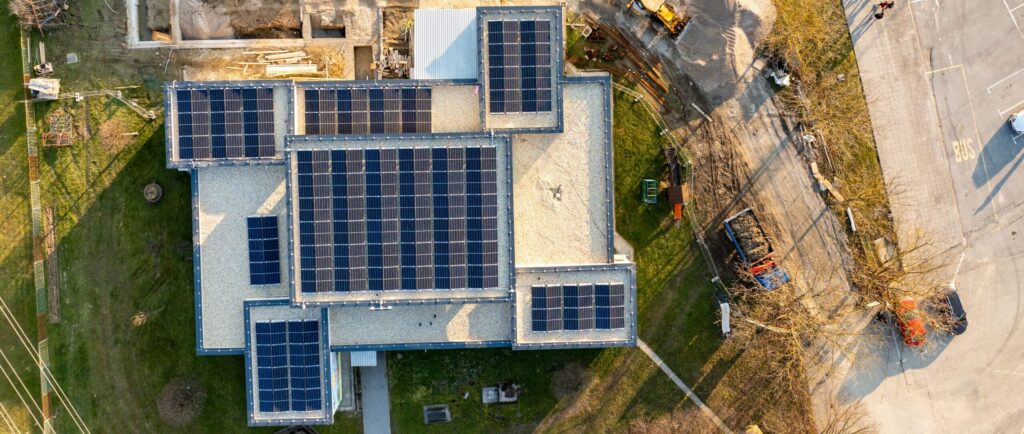
- Photovoltaic solar panels to produce decarbonized energy on site and reduce scope 2 emissions;
- Charging stations for electric vehicles, which contribute to decarbonizing business travel (scope 3).
Downstream: managing and optimizing over the long term
Decarbonization doesn't stop with the commissioning of equipment. To guarantee that objectives are met, Powesco ensures continuous monitoring and optimization:
- SEME (Energy Management and Monitoring System) to monitor consumption in real time and measure actual gains in relation to carbon footprint targets;
- BMS/TCMS (Building Technical Management / Centralized Technical Management) to automate the regulation of equipment, reduce waste and optimize performance in the long term.
This continuum (from diagnosis to action, from measurement to management) is what distinguishes strategic support from a simple consulting service. With Powesco, the scope 1, 2, and 3 carbon footprint assessment is not an end in itself: it is the starting point of a managed, financed, and measured decarbonization trajectory
Do you want to carry out your scope 1, 2, and 3 carbon footprint assessment and define your decarbonization strategy? Contact the experts at Act4Transition / Powesco to benefit from comprehensive support, from auditing to implementation.
Sources:
https://abc-transitionbascarbone.fr/bilan-ges-que-dit-la-loi/
https://abc-transitionbascarbone.fr/bilan-carbone/
FAQ
How to calculate scope 3 emissions efficiently?
Calculating Scope 3 is complex because it depends on external data from each supplier. To succeed, you need to:
- Define the organizational and operational scope
- Use a carbon accounting software solution to track data evolution.
- Collaborating with partners to measure the true footprint rather than using generic monetary ratios.
What is the link between carbon footprint and Net Zero strategy?
Conducting the assessment is only the first step. The ultimate goal is carbon neutrality or Net Zero. By identifying the areas where emissions are highest, the company can launch initiatives aimed at reducing its environmental footprint : switching to low-carbon energy, optimizing logistics, or eco-design.
Note: The Carbon Trust emphasizes that companies that integrate these indicators into their CSR gain a major competitive advantage in the fight against climate change.
Where can I find resources to explore this topic further?
To stay informed about the latest European Union regulations or to discover a concrete case study , you can:
- Check out our blog and our latest analysis.