
Whether you're a decision-maker in the industrial sector, a commercial property manager, or a healthcare facility manager, the challenge remains the same: transforming your unproductive spaces (roofs, parking lots) into genuine profit centers. But how do you practically move from simply paying energy bills to adopting an energy independence strategy?
In this comprehensive guide, we will explore the pillars of this transformation:
- Understanding the mechanism of self-consumption and its adaptation to your business needs.
- Decipher the regulatory framework (APER Law, Tertiary Decree, LOM Law) to anticipate your obligations.
- Discover third-party financing, the solution to solarize your site without tying up your cash flow.
What does self-consumption in business consist of?
Business self-consumption involves producing electricity on your premises (roof, parking lot, land) using photovoltaic panels for direct consumption. Unlike the total sale model, the energy is not fed back into the public grid: it powers your machines, servers, or lighting.
The goal is to achieve the best self-consumption rate by aligning your solar production curve with your activity peaks.
The 3 self-consumption models
Total self-consumption: closed-loop independence
Total self-consumption is the simplest solution, both technically and administratively. In this scenario, all the electricity produced by your solar panels is fed into your internal grid for immediate self-consumption .
- The principle: You do not feed any electricity back into the public grid . If your production exceeds your consumption at a given time (for example, a sunny Sunday at the factory), the power of the inverters is automatically limited to adjust to your actual need.
- Who is it for? This model is ideal for structures with a high "consumption base" (a constant minimum consumption), such as healthcare facilities or industries operating on a 3x8 schedule.
- The advantages: The process with the distribution network operator (Enedis) is simplified because there is no injection contract. This is the choice for a quicker connection to reduce your electricity bill without waiting for lengthy connection times.
Self-consumption with surplus sale: making the most of every kWh
This model is often the most profitable for companies whose activity varies (weekend closure, seasonality).
- The principle: You primarily consume your solar energy . If your production exceeds your needs, the surplus is fed into the grid. This surplus is then purchased by a designated buyer (often EDF OA ) or an alternative supplier at a purchase price guaranteed by a 20-year contract
- Who is it for? It's the ideal solution for the service (offices closed on Saturdays/Sundays) or agricultural buildings. It allows you to size a solar power plant to meet your future needs (such as the arrival of charging stations) without losing money today.
- The advantages: You maximize the benefit of your space . The surplus sold generates additional income that directly reduces the return on investment time for your project. It's financial security: every ray of sunshine is either energy savingsor gain .
Can electricity be shared between different sites?
Yes, that's the principle ofcollective self-consumption. You can share electricity among several consumers in the same area. It's an excellent way to increase the value of buildings and create a dynamic of sustainable development within an agency or business park.
In summary:
| Model | Description | Main advantage |
| total self-consumption | You consume 100% of your production. | Maximum administrative simplicity. |
| With sale of surplus | You consume what you need and sell the surplus on the network. | Profitability optimization (supplementary income). |
| collective self-consumption | You share energy between several sites or with neighboring businesses. | Local solidarity and sharing of infrastructure costs. |
Self-consumption for which companies?
All energy-consuming structures can now benefit from solar power, but the challenges vary depending on the sector:
Industry
With their large roof areas and often stable energy consumption throughout the day, industrial are ideal candidates. Solar power directly reduces the production cost of manufactured goods.
Tertiary
For office buildings , self-consumption is the perfect solution to air conditioning needs. The more the sun shines, the more your cooling needs increase, and the more your power plant produces: it's a natural and cost-effective synchronization.
Health
Clinics, hospitals and nursing homes operate 24/7. Self-consumption allows energy bills to be spread across the largest budget items and secures part of the supply.
Communities
Schools, gymnasiums or technical centers: communities are increasingly using self-consumption (often collective) to reduce public spending and set an example in local ecological transition.
How to finance your company's self-consumption project?
Financial aid and incentives
The State and local authorities encourage the transition through several mechanisms (subject to compliance with certain power criteria):
The Self-Consumption Bonus: Paid over 5 years, it concerns installations of less than 100 kWp.
| TOTAL POWER (P+Q) | INVESTMENT BONUS (€/WC) FROM 01/01/26 TO 31/03/26 |
| ≤9 kWp | 0,08 |
| ≤36 kWp | 0,14 |
The Guaranteed Purchase Tariff (EDF OA): A 20-year contract to sell your surplus at a price fixed by law.
| Installation power (kWp) | Buyback rate for surplus electricity (€/kWh) from 01/01/26 to 31/03/26 |
| ≤9 kWp | = €0.04/kWh |
| ≤36 kWp | = 0.0536 €/kWh (5.36 c€/kWh) |
VAT recovery: Businesses can usually recover VAT on investment and maintenance.
Local aid: Some regions or metropolitan areas offer specific subsidies for storage or feasibility studies.
Third-party financing
This is where the model is a game changer. Third-party financing allows a company to acquire equipment without spending a single euro of capital. Powesco finances, installs, and maintains the power plant at its own expense. You benefit from cheaper electricity from day one, without impacting your borrowing capacity.


The key steps to a successful project
- Consumption profile audit: Analyze your "load curves" (when do you consume the most?) to size the installation as accurately as possible.
- Structural study: Check that the framework of your building can support the weight of the panels.
- Choice of financing method: Own investment, bank loan, or third-party investment (a company installs the panels at your home and sells you the electricity at a reduced price).
- Administrative procedures: Prior declaration at the town hall, connection request and Consuel certificate.
A little extra tip: If your offices are empty on weekends but your panels are producing at full capacity, selling the surplus or installing charging stations for electric vehicles are essential options to avoid "losing" energy.
Why take the plunge now?
1. Cost control (the "shield" effect)
By producing your own energy, you lock in the cost of part of your consumption for 20 to 25 years. You are no longer directly affected by network tariff increases or fluctuating taxes.
2. Regulatory compliance
The legislator is accelerating the pace. Ignoringself-consumption projectsexposes you to penalties or the obsolescence of your real estate assets.
APER Law (Acceleration of Renewable Energies)
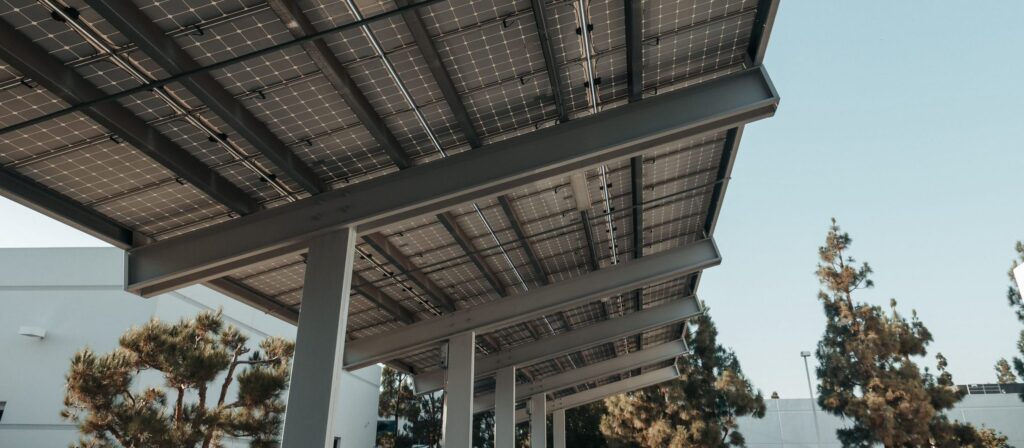
Since 2023, the APER law requires outdoor parking lots larger than 1,500 m2 to be equipped with photovoltaic canopies covering at least half of their surface area.
Energy Efficiency Directive / DDADUE
The DDADUE law strengthens the energy performance obligations of companies, imposing more frequent audits and a drastic reduction in energy waste.
Tertiary Decree
It mandates a reduction in final energy consumption for buildings larger than 1,000 m²: -40% by 2030, -50% by 2040 and -60% by 2050.Self-consumption is one of the few levers that allows these objectives to be achieved without changing your entire industrial process.
Greening of vehicle fleets / LOM Law
With the requirement to integrate electric vehicles into company fleets, charging needs are exploding. Self-consumption allows you to charge your vehicles with locally produced energy, without increasing your electricity bill.
3. Real estate valuation and CSR
A solar installation improves the Energy Performance Diagnosis (DPE) of your buildings and strengthens your brand image with customers and partners who are increasingly attentive to decarbonization criteria.
What is the environmental impact and lifespan of the panels?
Photovoltaic energy is a renewable energy source that drastically reduces your carbon footprint . The lifespan of a photovoltaic installation exceeds 30 years, offering lasting environmental and economic benefits . Unlike natural gas or nuclear power , solar energy provides a direct, carbon-free energy supply .
Self-consumption in business with Powesco
At Powesco, we believe that the energy transition shouldn't be a financial burden. Our expertise in business self-consumption allows us to support you from start to finish:
- Free technical and financial feasibility study.
- Zero investment: We finance the entire project.
- Maintenance and monitoring: We manage operations to ensure optimal performance.
- Total peace of mind: You focus on your core business, we take care of your energy.
The future of your business is solar. Don't let energy bills dictate your profitability.
FAQ
Is my company eligible for a solar installation?
Eligibility depends on your available space and electricity consumption . Whether you have industrial premises , an agricultural building , or a ground-mounted solar park , a feasibility study is required. Our experts analyze the potential installed surface area and the required installed capacity to maximize production based on your needs.
What is the price of a photovoltaic power plant and what subsidies are available?
The investment amount varies depending on the size of the solar power plant . However, thanks to government subsidies and the self-consumption bonus , the purchase cost is quickly recouped. There is also a feed-in tariff scheme (through EDF or another supplier ) for selling surplus electricity produced .