

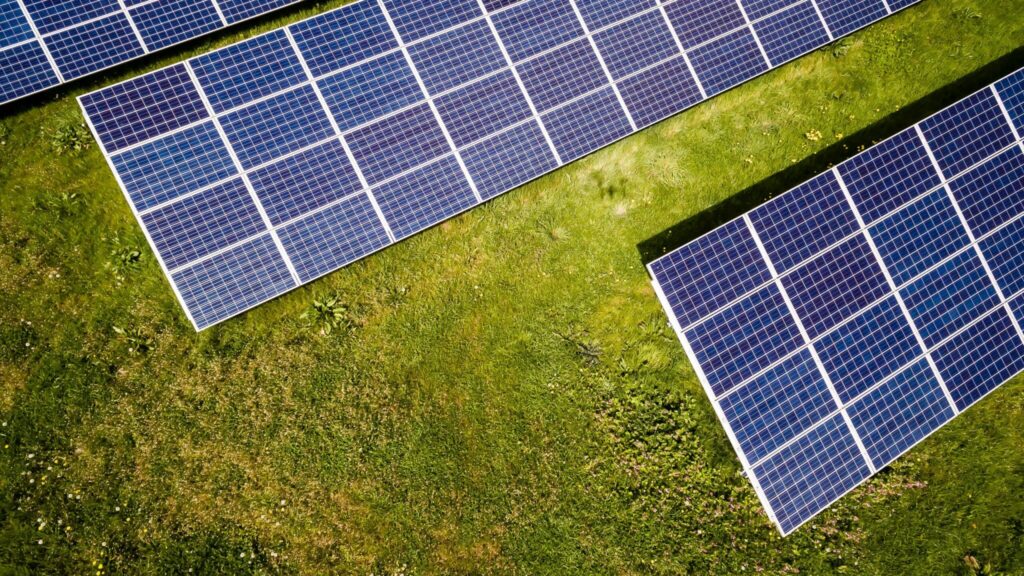
Thephotovoltaic carport is a sustainable, low-carbon solution that transforms a parking lot into a veritable solar power generation. Thanks to photovoltaic panels installed on a steel, it serves a dual purpose : protecting vehicles from the sun and inclement weather, and generating electricity from green energy. Used for self-consumption or to produce photovoltaic electricity fed into the grid, the energy produced contributes to reducing the carbon footprint and energy costs.
Average price, photovoltaic installation and regulations: this guide by Powesco helps you understand the challenges and advantages of a solar shade structure.
What is a photovoltaic shade structure?
A photovoltaic canopy is a structure installed over an outdoor space, most often a parking lot, whose roof is made up of solar panels. It serves a dual purpose: protecting vehicles from the elements and producing renewable electricity.
Unlike ground-mounted photovoltaic power plants, solar carports utilize existing developed land without requiring additional land. They are fully aligned with the energy transition objectives set by the government, particularly through the law accelerating the development of renewable energies.
There are several types of shade structures:
- Carport shade structures : the most common
- On a terrace : suitable for restaurant or shop owners with an outdoor sales area
- agricultural : to be installed in fields or pastures
- Street furniture or bus shelters : for local authorities wishing to reduce their energy budget or improve the comfort of their residents
How does a photovoltaic shade structure work?
The operation of a photovoltaic shade structure is based on a simple principle:
- The photovoltaic panels installed on the roof capture solar radiation
- The cells transform this energy into direct electrical current
- An inverter converts this current into usable electricity (alternating current).
- The solar electricity produced can be:
- self-consumed on site or stored in batteries (buildings, lighting, EV charging stations),
- or injected into the network with resale (total resale, partial resale, collective self-consumption)
Shade structures can also incorporate charging stations for electric vehicles, increasing their appeal to businesses and communities.
What are the legal obligations regarding shade structures?
Since Law No. 2023-175 of March 10, 2023 relating to the acceleration of the production of renewable energies (APER Law), specific obligations apply to outdoor parking lots.
Parking lots concerned
Outdoor parking lots:
- with a surface area exceeding 1,500 m²
- existing or new
- open to the public or for professional use
must be equipped with renewable energy production devices , mostly in the form of photovoltaic canopies .
Coverage rate
The obligation covers at least 50% of the parking area, excluding traffic lanes and technical areas.
Application deadlines
- Existing car parks larger than 10,000 m²: compliance by the latest date 2026
- Parking lots from 1,500 to 10,000 m²: deadline in 2028
- New parking lots: immediate obligation
Exceptions are possible (technical constraints, safety, heritage), but they must be justified and documented.
What are the penalties for non-compliance?
In the event of non-compliance, a financial penalty is imposed on the manager each year until the car park is brought into compliance, up to a maximum limit:
- of 20,000 euros if the park has an area of less than 10,000 m²;
- of 40,000 euros if the park has an area greater than or equal to 10,000 m².
This sanction is proportionate to the seriousness of the breach.
Photovoltaic canopies: for which structures?
Photovoltaic canopies are suitable for a wide range of stakeholders:
- Industrial and service companies
- Large retail spaces
- authorities (town halls, hospitals, schools)
- Logistics sites
- Private or public parking lot managers
Any structure with a significant size outdoor parking lot is potentially affected, either by obligation or by economic opportunity.
What are the advantages of photovoltaic shade structures?
The benefits are numerous:
- Renewable energy production without additional land development
- Protecting vehicles from heat, rain and hail, and improving the customer experience
- Compatibility with electric charging: especially since the LOM law also requires many companies to install charging stations and green their vehicle fleets.
- Reduction of CO₂ emissions in a context of significant decarbonization
- Site enhancement, development of sustainable mobility (if coupled with charging stations) and regulatory compliance
- Revenues generated through the resale of surplus energy or the charging of electric vehicle charging, as well as long-term energy savings
The photovoltaic canopy transforms a simple parking lot into an energy asset.


How to finance the installation of photovoltaic shade structures?
What is the cost of a photovoltaic shade structure?
The cost of a photovoltaic shade structure depends on several factors:
- parking area,
- installed power,
- complexity of the soil and foundations,
- electrical connection,
- options (charging stations, storage, control).
On average, the price ranges from €900 to €1,300 per kWp installed. However, profitability must be analyzed over the project's duration, taking into account:
- energy savings,
- resale revenues,
- potential assistance,
- and compliance with regulations.
Several financing models exist, depending on the objectives and investment capacity of the project sponsor.
Investment
Do you want to install and own a photovoltaic power plant? Powesco handles the study, design, installation, and commissioning of your photovoltaic power plant.
Leasing
Preserve your investment capacity and opt for financing your power plant through a financial lease (leasing). Powesco manages the investment in the power plant for you, in exchange for a monthly rental payment. Powesco handles the study, design, financing, installation, and commissioning of your photovoltaic power plant
Third-party investment
Do you own land (agricultural fields, sports fields, industrial wasteland) and wish to develop it with photovoltaics? Powesco installs and operates a photovoltaic power plant on your land and pays you rent in return.
Performance-guaranteed model
Do you want guaranteed energy performance for your installation? Adopt our innovative approach where Powesco finances the work and equipment and is compensated by retaining a portion of the energy savings generated, under a long-term contract.
How to install photovoltaic shade structures?
Installing photovoltaic canopies is a major project requiring a methodical approach that considers technical, regulatory, and economic factors. Here are the main steps to follow to ensure a compliant, high-performing, and sustainable project.
1. Study the feasibility of the project
The first step is to analyze the site where the parking lot will be located:
- available surface area and possible coverage rate
- orientation and sunlight
- technical constraints (existing networks, access, security),
- parking usage (public, private, traffic flow).
This study helps to determine the installable photovoltaic power and the economic viability of the project.
2. Check regulatory and urban planning requirements
Before any installation, it is essential to check:
- the subjection of the car park to the legal requirements for photovoltaic canopies,
- local urban planning regulations (PLU, protected zone, ABF),
- the necessary authorizations (prior declaration or building permit).
Upstream regulatory analysis helps to avoid any delays or administrative refusals.
3. Design the structure of the shade structures
The design of photovoltaic canopies includes:
- the dimensioning of structures (steel, aluminum),
- the integration of photovoltaic panels,
- taking into account safety standards and resistance to wind and snow.
The objective is to ensure both the durability of the structure and the comfort of parking lot users.
4. Define the method of electricity operation
Several options are possible depending on the site's needs:
- individual or collective self-consumption,
- resale, in whole or in part, of the electricity produced,
- power supply for charging stations for electric vehicles.
This choice has a direct impact on the profitability of the project and on the connection scheme.
5. Carry out the connection and the work
The work includes:
- the foundations and the installation of the shade structures,
- the installation of photovoltaic panels and inverters,
- connection to the electricity grid,
- the commissioning of the installation.
The intervention must be planned to limit the impact on the operation of the parking lot and carried out by a professional and qualified.
6. Ensure operation and maintenance
Once the photovoltaic canopies are operational, regular monitoring is necessary:
- monitoring of production and consumption via an energy monitoring (e.g., our SEME NEXTSTEP platform),
- preventive maintenance
- panel cleaning if necessary
- compliance and performance monitoring.
Proper maintenance guarantees optimal production for 25 to 30 years.
Ahmed BOUCHRIHA
Solar expert at Powesco
“Powesco’s solar engineers have the unique ability to not only design power plants but also manage the construction work. This comprehensive approach allows us to support clients from defining their needs to commissioning the plant. We are also responsible for preliminary studies and additional work (structural reinforcement and roof repairs, soil studies and earthworks, etc.). A single point of contact to guide clients throughout their entire project.”
Sources:
- https://www.oise.gouv.fr/Actions-de-l-Etat/Amenagement-durable-du-territoire/Transition-Ecologique-et-Energetique/Energies-renouvelables/La-loi-d-acceleration-pour-les-energies-renouvelables/Les-panneaux-photovoltaiques-sur-parkings
- https://www.herault.gouv.fr/Actions-de-l-Etat/Transition-energetique/Obligations-d-ombrieres-photovoltaiques-sur-les-parkings/Obligation-d-installer-des-ombrieres-sur-les-parkings-exterieurs-de-plus-de-1-500-m2
- https://www.herault.gouv.fr/contenu/telechargement/51472/381828/file/Guide-parcs-de-stationnement.pdf