

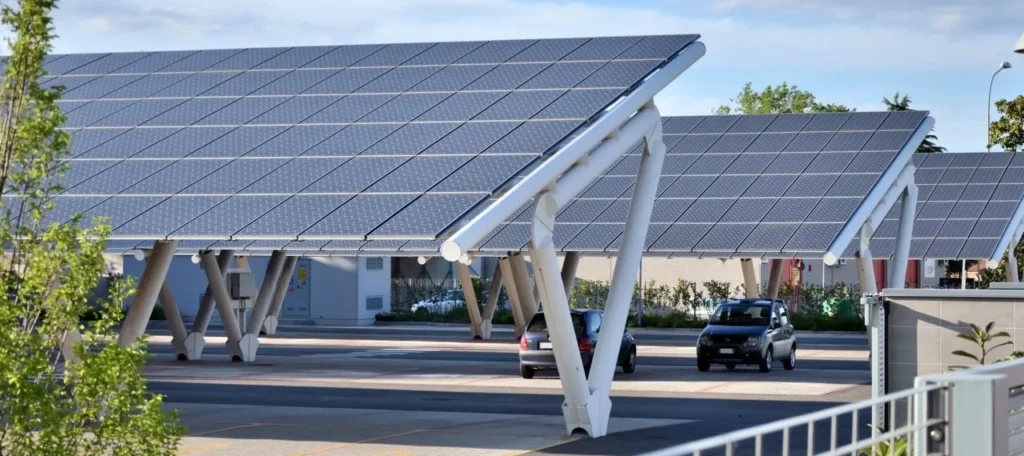
The APER law, adopted in March 2023, requires outdoor parking lots larger than 1,500 m² to be equipped with photovoltaic canopies covering at least half of their surface area. This measure is part of a broader effort to develop renewable energy without further artificializing land. In 2025, the proposed law to simplify urban planning and housing will relax some of these requirements. Nevertheless, these installations remain a key tool for meeting climate objectives and generating revenue from land that has been largely untapped until now. Powesco tells you more about it!
What are the implications of the APER law?
The APER law addresses several strategic challenges:
- Energy transition : support for the development of renewable energies
- sustainable development : reduction of soil sealing
- Comfort : shade during the summer
- financial : land deposit
The installation of photovoltaic canopies is in line with the environmental policies promoted by:
- The 2016 Biodiversity Law : the first to mandate the integration of stormwater management systems in new parking lots
- and the Climate and Resilience Law of 2021 : which broadened the scope of buildings and car parks covered by the obligation
Which company car parks are affected by the APER law?
Car parks larger than 500 m2: Climate and Resilience Law
Since August 2021, outdoor parking lots larger than 500 m² must:
- be shaded by at 50% (solar shade structures or trees, vegetated pergolas);
- integrate a stormwater management system over at least 50% of their area.
Parking lots larger than 1500 m2: APER law
The APER law complements and clarifies these requirements: any outdoor parking lot of more than 1500 m² must be equipped with photovoltaic canopies covering at least half of its surface area.
Typologies concerned
An outdoor parking area is defined here as the set of marked spaces, traffic lanes, pedestrian/cyclist zones… excluding through roads (street, avenue…) separating the parking area and green spaces.
This includes:
- areas ,
- motorway car parks ,
- logistics spaces ,
- parks same building or real estate complex.
Exceptions to the APER law
The obligation does not apply:
- if the site is already equipped with an equivalent renewable energy system;
- in the event of proven technical, heritage or landscape constraints ;
- if the investment is not economically viable;
- if trees already provide natural shade over at least 50% of the area;
- if the car park is destined to disappear or be redeveloped in the short term.
A case-by-case examination is necessary in protected areas (historical monuments, coastline, etc.).
What are the penalties for non-compliance?
Failure to comply with this obligation will result in an annual financial penalty :
- €20,000 for a parking lot < 10,000 m²,
- €40,000 and beyond.
The penalty is proportionate to the seriousness of the breach and remains applicable until compliance is achieved.
What are the deadlines for the APER law?
The obligation schedule varies depending on the nature of the infrastructure
- For new or recently built parking lots
The following parking lots are affected:
- existing as of July 1, 2023,
- or whose planning application was submitted from March 10, 2023 onwards.
- For car parks not managed under a public service delegation (DSP)
- > 10,000 m²: compliance by July 1, 2026;
- 1,500 to 10,000 m²: no later than July 1, 2028.
- For car parks under public service delegation (DSP)
- Contract concluded or renewed before July 2026: obligation from July 1, 2026;
- Contract renewed after July 2026: obligation on July 1, 2028.
- Possible extension
A deferral may be granted for up to 5 years + an additional 2 years, in the event of:
- redevelopment project led by a local authority;
- delay not attributable to the manager (appeals, administrative delays, etc.).


APER Law: Towards a relaxation?
In response to the complexity of planning procedures (long delays, numerous appeals, etc.) and the financial difficulties of local authorities, the proposed law to simplify planning and housing law aims to relax certain obligations imposed by the APER law.
The objective is to postpone certain deadlines and reduce the regulatory burden on medium-sized parking lots (until early 2030 for parking lots between 1,500 and 10,000 m²). Furthermore, solar installation procedures could also be streamlined for certain self-consumption scenarios to accelerate their implementation.
Good to know: On July 3, 2025, a compromise was reached on a final version of the bill. This version is scheduled to be votedon by the Senate on July 9.
Even though the requirements of the APER law are currently being adjusted, the general trend remains towards stricter energy requirements for businesses ( tertiary sector decree , LOM law, etc.). A future tightening of the regulatory framework is therefore far from out of the question. It's best to get ahead of the curve now. By equipping your parking lot with photovoltaic canopies, you make better use of often underutilized land , reduce your energy costs through solar self-consumption , and enhance your CSR approach by offering greater comfort to your visitors and employees.
How to comply with the APER parking law?
Powesco, an energy services integrator, provides comprehensive support comply with the APER law. We have a dedicated solar management team to help you anticipate deadlines and maximize the value of your land.
- regulatory feasibility study (including exceptions and local constraints),
- technical design of your photovoltaic shade structure project
- Third-party financing and contracting
- Installation : possibility of connecting to electric charging stations (electric mobility) or deploying photovoltaic canopies for your sports fields: tennis courts, bowling greens…
Request a quote from us!
Sources: