

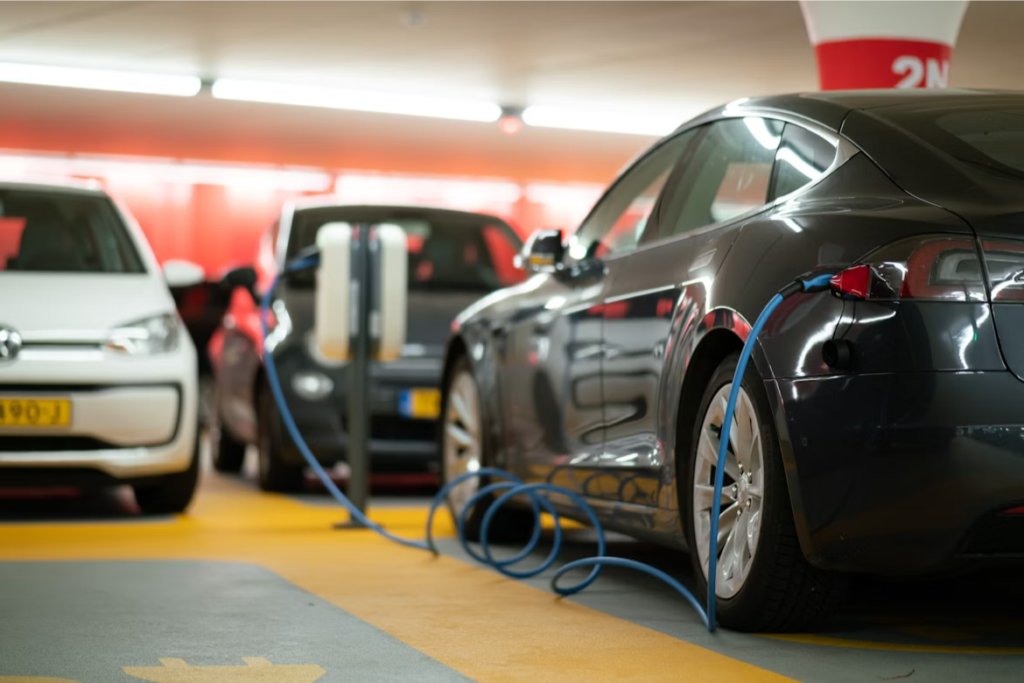
The energy transition is a major challenge for businesses, particularly in terms of professional mobility. With the implementation of the LOM law and schemes such as the Advenir grants for the installation of electric vehicle charging stations, greening vehicle fleets is becoming a strategic priority.
For companies, adopting electric, hybrid or hydrogen vehicles is not just about meeting legal obligations: it is also an opportunity to reduce fuel costs, decreasecarbon footprint, improvebrand image and anticipate regulatory changes related to sustainable mobility.
Powesco supports companies in this process by offering concrete solutions to optimize fleet energy consumption , accelerate their ecological transition and achieve their decarbonization goals .
What is the greening of the vehicle fleet?
Greening the vehicle fleet involves gradually replacing internal combustion engine vehicles (petrol or diesel) with low or zero emission vehicles , such as electric, plug-in hybrid or hydrogen- powered cars .
But this approach is not limited to changing engines: it is part of a comprehensive sustainable mobility strategy, including reducing the number of vehicles, sharing, teleworking, eco-driving and installing suitable infrastructure.
Environmental and economic challenges
1. Reduce the carbon footprint
The transport sector accounts for nearly 30% of CO₂ emissions in France. By opting for an electric fleet, companies actively contribute to the energy transition and the carbon neutrality target set for 2050.
2. Anticipate regulations
The LOM law
The Mobility Orientation Law (LOM) and the Climate and Resilience Law are progressively requiring businesses and local authorities to integrate low-emission vehicles when renewing their fleets. These laws set a minimum renewal rate that must be met, which increases over the years in order to accelerate the transition to low-carbon mobility.
Good to know: What are the penalties for not meeting quotas? Failure to comply with the quotas imposed by law can result in a financial penalty in the form of a fine or an annual levy . This annual incentive tax aims to encourage the gradual replacement of internal combustion engine vehicles and to support the fleet renewal rate in favor of electric or hybrid models
By anticipating these regulatory changes, companies not only avoid the costs associated with these penalties, but they also gain a competitive advantage in terms of image and environmental compliance.
The CSRD directive: reporting obligation
The Corporate Sustainability Reporting Directive (CSRD) requires European companies to publish detailed information on their environmental, social, and governance (ESG) performance. This includes energy consumption, CO₂ emissions,resource use, and measures taken to reduce environmental impact. The directive aims to increase transparency for investors, customers, and stakeholders, and encourages companies to integrate sustainability into the core of their strategy.
Low Emission Zones (LEZs): an incentive for cleaner fleets
Low Emission Zones (LEZs) are being implemented in many cities to limit the circulation of polluting vehicles and improve air quality. Businesses must adapt their vehicle fleets to maintain access to urban centers. This involves electrifying commercial vehicles , using hybrid or low-emission vehicles, and planning optimized routes to reduce emissions. LEZs are therefore becoming a strategic tool for companies seeking to reconcile mobility, operational efficiency, and environmental responsibility .
Companies that begin their greening efforts today are anticipating these legal obligations and complying before stricter thresholds come into effect.
Read also: Large company car parks regulated by the APER law
3. Control costs
Even if the initial investment may seem higher, the total cost of ownership (TCO) of an electric vehicle is lower over time : less maintenance, reduced energy cost, tax exemptions and government subsidies.
4. Enhancing your image
Adopting a clean fleet also strengthens the company's eco-responsible image with its customers, partners and employees: an essential asset in a context of strong environmental awareness.
What are the possible actions to make your vehicle fleet more environmentally friendly?
Greening a vehicle fleet isn't simply a matter of replacing combustion engine vehicles with electric models. It's a comprehensive approach, combining vehicle acquisition strategy, operational optimization, and a transformation of usage patterns. Here are the key levers to activate to successfully achieve this ecological transition.
1. Gradually renew the vehicle fleet
The first step is to plan the replacement of the most polluting vehicles with low-emission models: electric, plug-in hybrid or hydrogen.
This renewal can be achieved through purchase or long-term leasing (LLD), in order to spread out the investment and more easily integrate technological advancements.
Companies can also benefit from advantageous financial mechanisms, such as the depreciation of electric vehicles, to reduce the initial cost.
Good to know: In 2025, companies can depreciate their 100% electric cars on a deductible basis capped at €30,000 excluding VAT over 5 years. This tax advantage is accompanied by deductible VAT on charging electricity, further incentivizing the switch to electric vehicles. Conversely, hybrid vehicles are losing certain tax advantages, which is accelerating the transition to zero-emission fleets.
Read also: How to reduce the carbon footprint of your purchases?
2. Implement intelligent fleet management
Connected fleet management optimizes usage while reducing costs and emissions. Thanks to onboard telematics , it becomes possible to monitor energy consumption, mileage, and downtime in real time. Analyzing this data facilitates preventative maintenance and route optimization, ensuring more fuel-efficient and effective vehicle operation.
3. Train employees in eco-driving
A clean vehicle isn't enough: you also need to adopt responsible driving habits. Eco-driving training helps reduce energy consumptionwhile also decreasing tire and brake wear. It's a simple action, but with a significant environmental and economic impact.
4. Promote alternative modes of transportation
Finally, greening your fleet also means reducing reliance on private cars. Implementing complementary solutions (carpooling, shared vehicles, company bikes, or employer mobility plans) allows you to reinvent business travel. These initiatives contribute both to reducing CO₂ emissions and improving employee well-being.


Concrete example: how to make your fleet greener with Powesco
Let's take the example of a company with a fleet of 200 utility and commercial vehicles spread across several sites in France. Faced with rising fuel costs and traffic restrictions in Low Emission Zones (LEZs), it wants to initiate a transition to electric mobility.
Step 1: Diagnosis and transition plan
The first step is to conduct a complete audit of the existing fleet : vehicle types, annual mileage, daily usage, parking locations, and energy constraints. Based on this analysis, a greening plan is proposed.
- Gradual replacement of vehicles each year with suitable electric models (utility vehicles or sedans).
- Installation of an internal network of charging stations in the parking lots of the various sites.
- Forecast of an energy mix combining grid charging and local solar production.
Step 2: Installation of charging stations and energy infrastructure
Powesco provides turnkey delivery and installation of charging stations adapted to each site:
- stations (22 kW) for daily charging at the office,
- charging stations (50 to 100 kW) at logistics sites for high-turnover vehicles.
The main car parks are equipped withphotovoltaic canopies, allowing some of the electricity needed for charging to be produced while also providing shelter from the sun and inclement weather.
Step 3: Intelligent monitoring and control
Thanks to the Powesco monitoring, the fleet manager can track in real time:
- The condition of the terminals,
- The charging sessions,
- Energy consumption,
- CO₂ emissions avoided.
This visibility and intelligent control allows foroptimized energy management and prioritizes solar charging when production is available, further reducing the electricity bill.
Step 4: Ongoing maintenance and support
Powesco remains involved throughout the entire duration of the project:
- Preventive and corrective maintenance of terminals,
- Technical assistance in case of breakdown or incident,
- Periodic reports on the energy performance and carbon impact of the park.
As a result, the company reduces its greenhouse gas emissions related to mobility, while improving its budget control and its environmental image with its customers and partners.
Step 5: Photovoltaic canopies: energy at the service of charging
We also offer the installation ofphotovoltaic canopies in company parking lots. These structures produce solar energy directly on-site, allowing for:
- Recharging vehicles usingrenewable energy ;
- Reduce your energy bill ;
- Enhance your outdoor spaces while providing sun protection for vehicles.
Read also: What are the levers for optimizing energy efficiency in business?
Why choose Powesco
- Comprehensive support from start to finish : study, installation, supervision, maintenance
- ⚙️ Customized solutions based on your usage and fleet type
- Clean, local energy thanks to photovoltaic canopies
- ♻️ Strong commitment to the decarbonization of mobility
In summary
Greening your vehicle fleet is no longer an option: it's an ecological, economic, and regulatory imperative. With Powesco, you have a single partner to successfully navigate this transition, while benefiting from a comprehensive, reliable, and scalable solution.
Contact Powesco today for a free study of your fleet greening project and the installation of smart charging stations and photovoltaic canopies .
FAQ
Reduced-rate TICGN: How to ensure traceability and reporting of emissions in a vehicle fleet?
With new reporting obligations, particularly those related to the CSRD directive and the Climate and Resilience Law, companies must collect accurate data on the use of their vehicle fleet and the greenhouse gas emissions . This includes:
- real-time fuel or electricity consumption ,
- monitoring the renewal rate and theintegration of low-emission vehicles,
- calculating thecarbon footprint per site or service.
Accurate reporting allows foroptimized fleet management, compliance with clean vehicle quotas, and improved brand image while anticipating sanctions or penalties.
Sources: